
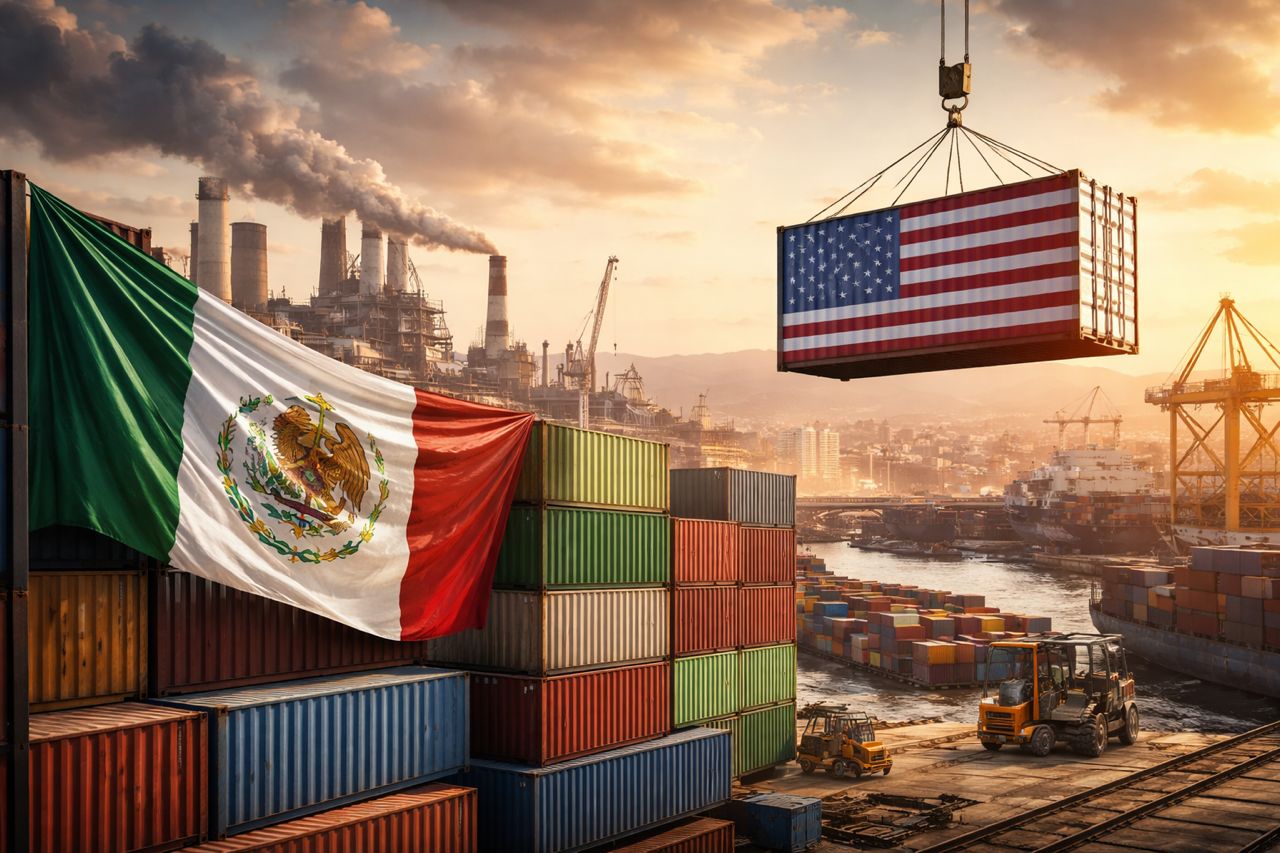
After a complex year marked by US President Donald Trump’s trade war, Mexico is entering 2026 with heightened challenges due to tariff uncertainty and the review of the United States-Mexico-Canada Agreement (USMCA), which experts predict will be the primary source of volatility next year.
José Ignacio Martínez, coordinator of the Laboratory for Analysis in Trade, Economy, and Business (LACEN), said to the Spanish news agency EFE that Mexico’s economy is experiencing weak investment and industrial production, as well as caution among enterprises and consumers, as it approaches 2026.
Despite positive variables such as inflation, the exchange rate, and interest rates, he believes their impact has yet to result in a clear domestic economic revival.
Martínez predicts that the first half of 2026 will be focused on the revision of the deal, with Trump potentially using tariffs as a negotiation tool on multiple fronts.
He cited calls for migration control, the fight against fentanyl, and limits to limit China’s involvement in the Mexican market, among other challenges.
Global backdrop weighs on outlook
During her usual press conference on Monday, Mexican President Claudia Sheinbaum emphasised the global backdrop as a key issue for the current year.
“I think 2025 was a complex year, above all due to the entry of President Trump and the new global trade model decided by the United States government,” she said.
The global environment, along with domestic fragilities, sets a cautious baseline for experts as Mexico prepares for a year marked by trade discussions and policy uncertainties.
GDP growth expectations diverge
Janneth Quiroz Zamora, Monex’s director of Economic, Currency, and Equity Analysis, acknowledged the risks of tariffs and uncertainty surrounding the USMCA, but provided a less negative base-case scenario.
“We envision a favourable negotiation process for the country,” she said to EFE.
Quiroz anticipated that Mexico’s GDP would expand by 1.3% in 2026, compared to 0.4% in 2025.
She ascribed the improvement to lower interest rates, economic spillovers from the FIFA World Cup, and the possibility of gaining market share in North America over China.
In contrast, Gabriela Siller, director of Economic and Financial Analysis at Banco Base, stated that “2026 will be a year with many economic challenges,” noting economic stagnation and a likely comeback in inflation.
She cautioned that the year could be “misleading,” as the World Cup may create a sense of excitement that distracts from underlying issues.
Siller noted that the peso’s appreciation and growth faster than in 2025, estimated by Banco Base at 0.4% in 2025 and 0.8% in 2026, could provide the impression that the economy is doing well, even if the expansion remains insufficient.
USMCA is viewed as a central event
Analysts generally agree that the USMCA review will be the key event in 2026.
According to Banorte’s Economic Analysis team, the external environment points to a hard scenario, and Trump’s tariff policy may continue to be used as a “negotiating instrument” throughout the agreement’s review.
Banorte observed that trade integration with the United States serves as a “differentiator” for Mexico and has the potential to preserve advantages resulting from production chain reconfiguration and physical closeness.
Enrique Covarrubias, Actinver’s chief of analysis, also identified the USMCA as the most important event of 2026.
He said the process could result in a renewal that extends the agreement’s duration to 2046.
In another possibility, he predicted a deeper renegotiation if any side chose not to renew the agreement, even though it would stay in effect until 2036.
Official optimism contrasts with risks
In contrast to experts’ risk-focused assessments, Sheinbaum has always expressed confidence in the treaty’s review.
On December 19, she stated that she was “very optimistic” about the USMCA process, adding, “We are on the right track.” “The Mexican economy will be fine by 2026.”
As Mexico looks ahead, analysts say the mix of external pressures and domestic resilience will determine whether optimism can counter the uncertainty around tariffs and the future of North America’s primary trade agreement.
The post Mexico braces for trade turbulence as USMCA review looms in 2026 appeared first on Invezz
