
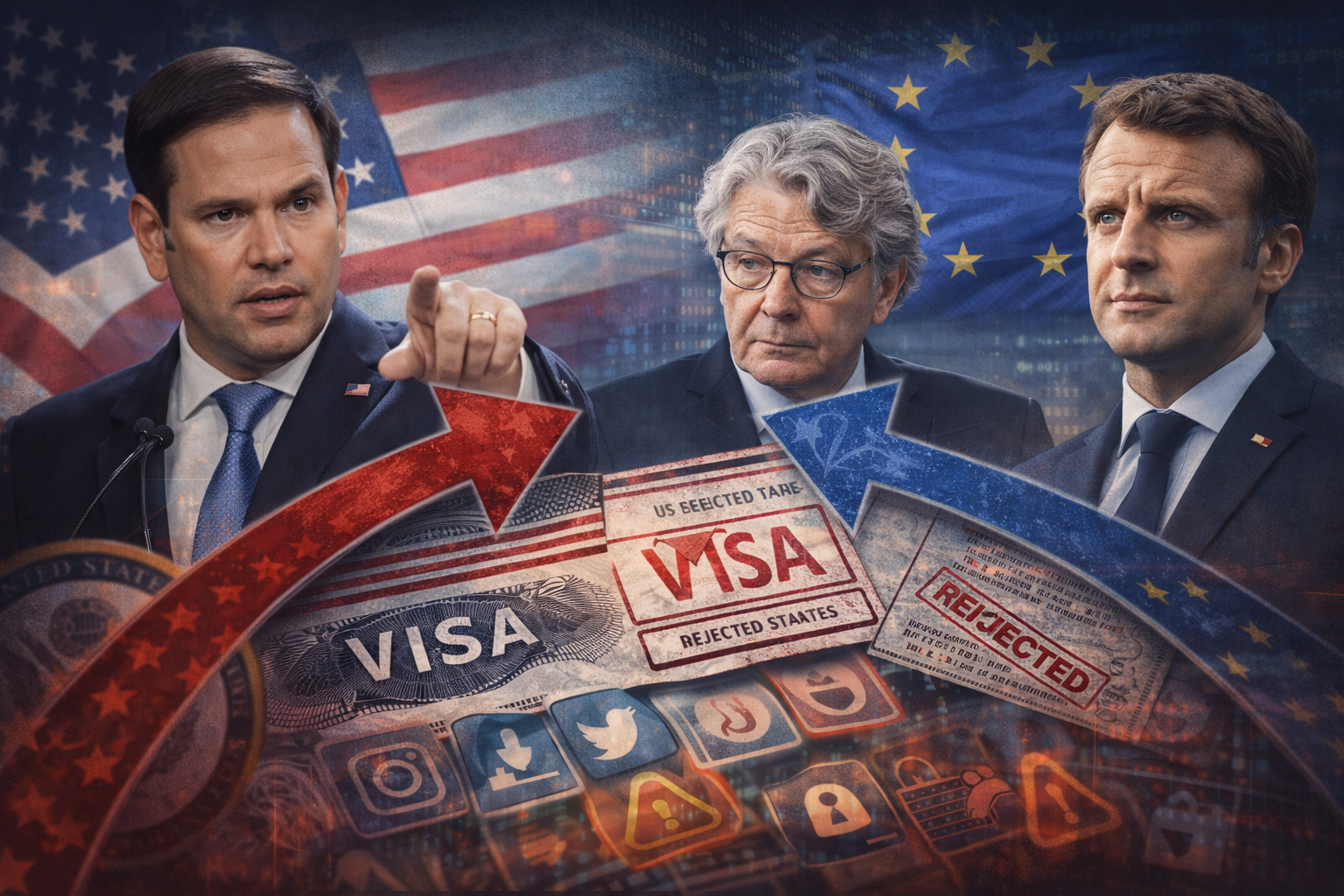
The United States has sharply escalated its confrontation with Europe over digital regulation, imposing visa sanctions on former European Union officials and leaders of anti-disinformation groups in a move that has drawn swift condemnation from across the Atlantic.
The sanctions, announced on Tuesday by the US State Department, target a former senior EU official and several individuals associated with organisations that monitor online disinformation.
The move reflects mounting frustration in Washington over European efforts to regulate large technology platforms and rein in the influence of Big Tech companies, many of which are American.
US Secretary of State Marco Rubio said the individuals had led “organized efforts to coerce American platforms to censor, demonetize, and suppress American viewpoints they oppose”, accusing them of advancing what he described as foreign-led censorship of American speech and companies.
“These radical activists and weaponized NGOs have advanced censorship crackdowns by foreign states — in each case targeting American speakers and American companies,” Rubio said in a statement.
For far too long, ideologues in Europe have led organized efforts to coerce American platforms to punish American viewpoints they oppose. The Trump Administration will no longer tolerate these egregious acts of extraterritorial censorship.
Today, @StateDept will take steps to
55.1K
Reply
Copy link
Who are the five European nationals who have been sanctioned?
Among those sanctioned is Thierry Breton, a former European commissioner who played a central role in shaping the EU’s Digital Services Act, a sweeping law that requires online platforms to tackle illegal and harmful content more aggressively.
The visa restrictions also apply to British citizens Imran Ahmed, head of the Centre for Countering Digital Hate, and Clare Melford, who leads the Global Disinformation Index.
According to the Telegraph, Ahmed, who is based in Washington, now faces immediate deportation.
German nationals Anna-Lena von Hodenberg and Josephine Ballon, senior figures at Hate Aid, a non-profit organisation focused on tracking far-right disinformation online, were also included in the sanctions.
Part of a broader warning to allies
The move marks the latest warning shot from the US administration against European regulation of digital platforms, which Washington has repeatedly portrayed as an attempt to censor speech and unfairly target American companies.
Earlier this month, Elon Musk-owned social media platform X was fined €120 million by EU regulators for breaching content moderation rules, further fuelling tensions.
Senior Trump administration officials have criticised such enforcement actions, arguing they threaten free expression and undermine US economic interests.
The State Department’s most recent human rights report also accused several US allies, including the United Kingdom, France and Germany, of imposing “serious restrictions on freedom of expression”.
How did European leaders hit back?
European officials reacted swiftly, framing the sanctions as an attack on democratic oversight and regulatory independence.
French President Emmanuel Macron condemned the move, describing it as intimidation aimed at weakening Europe’s digital sovereignty.
“France condemns the visa restriction measures taken by the United States against Thierry Breton and four other European figures,” Macron said in a post on X.
“Together with the European Commission and our European partners, we will continue to defend our digital sovereignty and our regulatory autonomy.”
France condemns the visa restriction measures taken by the United States against Thierry Breton and four other European figures.
These measures amount to intimidation and coercion aimed at undermining European digital sovereignty.
10.3K
Reply
Copy link
The European Commission echoed those concerns, saying it had sought clarification from US authorities and would respond if necessary to protect its regulatory framework.
Growing political divide over online speech
Breton himself questioned the motivations behind the sanctions, comparing them to Cold War-era political persecution.
“Is McCarthy’s witch hunt back?” he wrote on X, adding that censorship was being mischaracterised. “To our American friends: censorship isn’t where you think it is.”
The Trump administration has made opposition to European digital rules a consistent theme.
Vice President JD Vance has repeatedly criticised the EU for what he calls attacks on free speech and American technology companies, arguing that digital regulation is being used as a political weapon.
Negotiation tactic or deeper rupture?
According to Politico, tech policy experts say the sanctions may be intended less as punitive measures and more as a negotiating signal.
By targeting individuals rather than imposing broader economic penalties, Washington may be seeking to pressure European regulators while avoiding a full-blown trade dispute that could damage the US economy.
Still, the episode underscores the deepening divide between the US and Europe over how online platforms should be governed — and suggests that clashes over digital sovereignty, free speech and corporate power are likely to intensify in the months ahead.
The post Why US sanctioned former EU official, 4 others; what it says about transatlantic tech rift appeared first on Invezz
